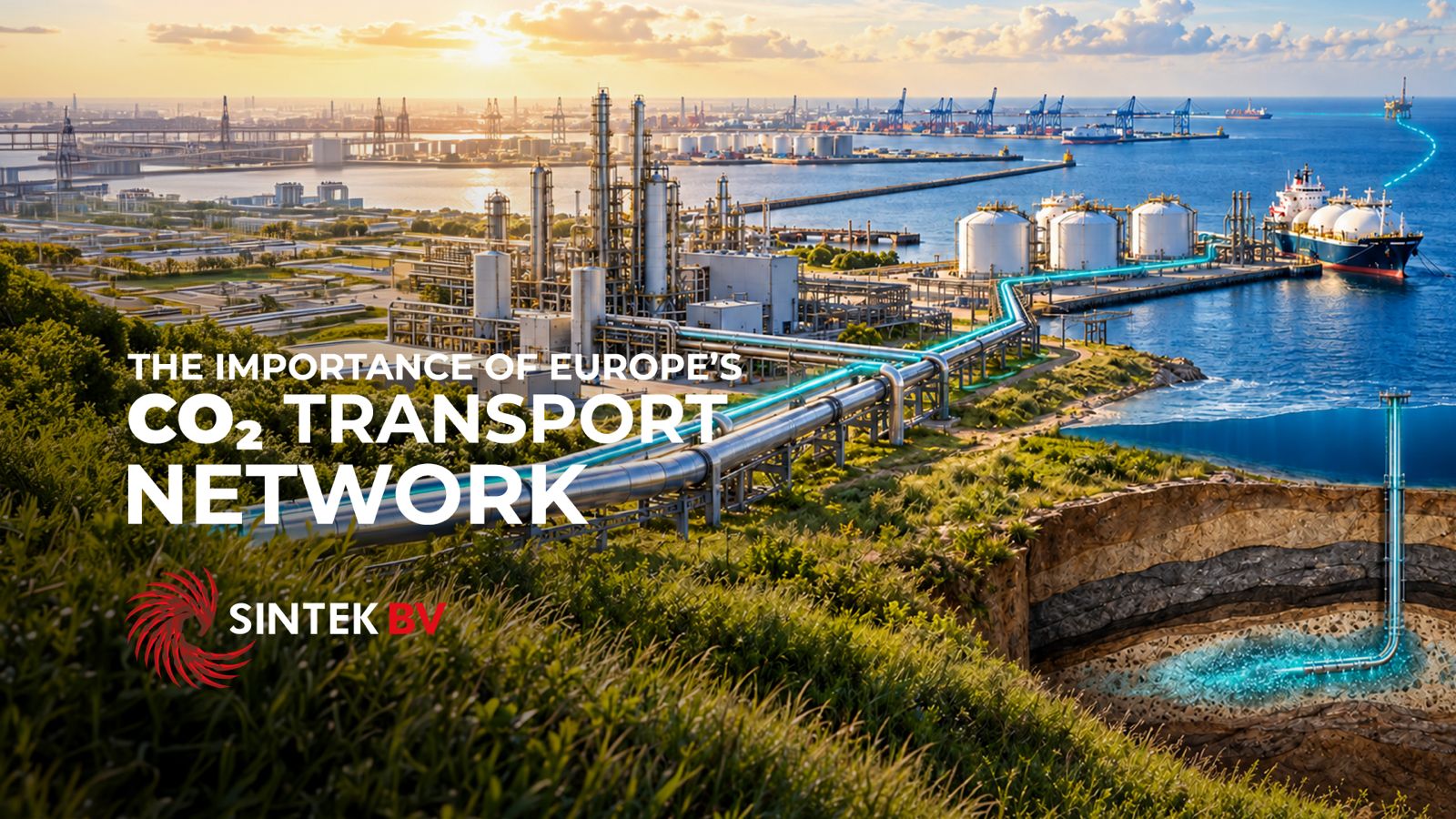
Europe’s ambition to decarbonise industry extends beyond capturing carbon emissions. How captured CO₂ is transported, where it is stored, and how these processes are integrated into reliable industrial infrastructure are equally important. As Europe progresses towards its climate neutrality goals, CO₂ transport networks are becoming a critical link between industrial emission sources and permanent storage sites.
Carbon capture, utilisation and storage (CCUS) technologies are becoming increasingly important in sectors where emissions are particularly difficult to reduce, such as cement, iron and steel, and chemicals. However, fully realising the potential of these technologies requires more than capturing CO₂ alone. The infrastructure needed to transport captured carbon efficiently from industrial facilities to suitable utilisation or storage sites must also be developed.
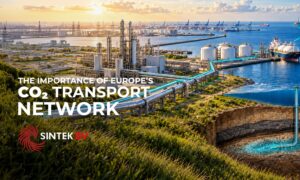
Europe’s emerging CO₂ transport network plays a vital role in this process. Pipelines, shipping routes, liquefaction terminals, compressor stations and intermediate storage facilities are being developed to connect industrial clusters with permanent storage sites, including geological storage formations beneath the North Sea. These connections enable CO₂ to be transported across regions and national borders, creating new opportunities for industrial facilities without access to local storage capacity. The European Commission considers transport infrastructure a fundamental component of developing industrial carbon management and establishing a functioning European CO₂ market.[1]
The scale of this transformation is also reflected in the European Union’s infrastructure investments. According to the European Climate, Infrastructure and Environment Executive Agency (CINEA), the European Union has provided more than €979 million in support for 28 CO₂ network projects under the Connecting Europe Facility for Energy programme since 2019. Once completed, these projects are expected to cover approximately 4,800 kilometres of pipelines and provide the capacity to transport more than 231 million tonnes of CO₂ annually. These figures demonstrate the scale of infrastructure required to achieve Europe’s decarbonisation ambitions.[2]
The Netherlands is emerging as a key hub within this developing network. Its industrial ports, existing energy infrastructure and proximity to storage resources in the North Sea make the country a strategic centre for cross-border CO₂ transport. The Porthos project, which aims to transport CO₂ captured from industrial facilities in the Port of Rotterdam to depleted natural gas fields beneath the Dutch North Sea, is a tangible example of this approach. Meanwhile, the CO₂ TransPorts initiative aims to connect major industrial hubs, including Rotterdam, Antwerp and North Sea Port, extending the benefits of shared infrastructure beyond national borders.[3]
Recent developments also demonstrate how these connections can operate in practice. In September 2026, the European Commission announced that the Yara Sluiskil carbon capture and storage facility in the Netherlands had become operational. The facility is expected to capture and liquefy up to 800,000 tonnes of CO₂ annually, with the CO₂ planned to be transported by ship to Norway for permanent storage beneath the North Sea. This model demonstrates how industrial facilities, transport systems and storage infrastructure can be interconnected to form a Europe-wide carbon management network.[4]
However, developing such a network involves far more than laying pipelines or establishing shipping routes. It requires the integrated consideration of multiple engineering factors, including infrastructure design, material selection, pressure management, operational reliability, safety and integration with existing industrial facilities. Transport methods and infrastructure configurations must be assessed according to distance, volume, location and project-specific technical requirements. Ensuring interoperability between projects in different countries, alongside long-term investment planning, is also critical to establishing an integrated European network.
From EPC Design to Heavy Fabrication & Modular Integration
Moving CO₂ at high pressures and managing liquefaction or terminal interface systems demands robust heavy engineering, precise material specification, and high-standard modular manufacturing. Through Sintek Heavy, we bring specialized capacity in high-specification heavy mechanical fabrication, pressure-rated equipment manufacturing, and complex structural module assembly tailored for high-demand industrial environments.
This transformation also creates an important area of expertise for engineering companies. Developing CO₂ transport infrastructure requires the integrated assessment of industrial processes, energy systems, project engineering and infrastructure performance. Engineering solutions must address not only the construction of new facilities but also the integration of carbon management systems into existing industrial structures. This integration is an essential part of the wider transition.
Positioning Sintek BV at the Heart of Europe’s Carbon Hubs
Developing cross-border CO₂ transport infrastructure requires an integrated engineering perspective that connects energy systems, industrial plant brownfield modifications, and carbon management logistics. Operating from the Netherlands—a primary node in Europe’s CO₂ network with flagships like Porthos and CO₂ TransPorts—Sintek BV bridges high-level process engineering with complex EPC project execution. We focus on integrating carbon capture, liquefaction interface, and intermediate storage units directly into hard-to-abate industrial plants (such as cement, lime, and heavy process industries) without disrupting ongoing operations.
As Sintek Group, we view the expansion of Europe’s CO₂ transport network not just as a logistical necessity, but as the foundational backbone of industrial transformation. By leveraging the combined strengths of Sintek BV (project management, engineering, and European site execution) and Sintek Heavy (heavy fabrication, equipment manufacturing, and construction capability), we provide heavy industrial players with complete, end-to-end EPC solutions.
From feasibility and process integration to heavy manufacturing and commissioning of CO₂ handling infrastructure, Sintek Group stands ready to build the physical connections that turn Europe’s net-zero ambitions into operational reality.
[1] https://energy.ec.europa.eu/topics/carbon-management-and-fossil-fuels/industrial-carbon-management_en
[2] https://cinea.ec.europa.eu/co2-networks_en
[3] https://cinea.ec.europa.eu/news-events/news/cef-energy-visiting-porthos-co2-transport-backbone-port-rotterdam-area-2025-03-19_en
[4] https://energy.ec.europa.eu/news/commission-inaugurates-europes-largest-industrial-carbon-capture-and-storage-facility-netherlands-2026-09-07_en

Bunlara Göz Atmak İster Misiniz?